
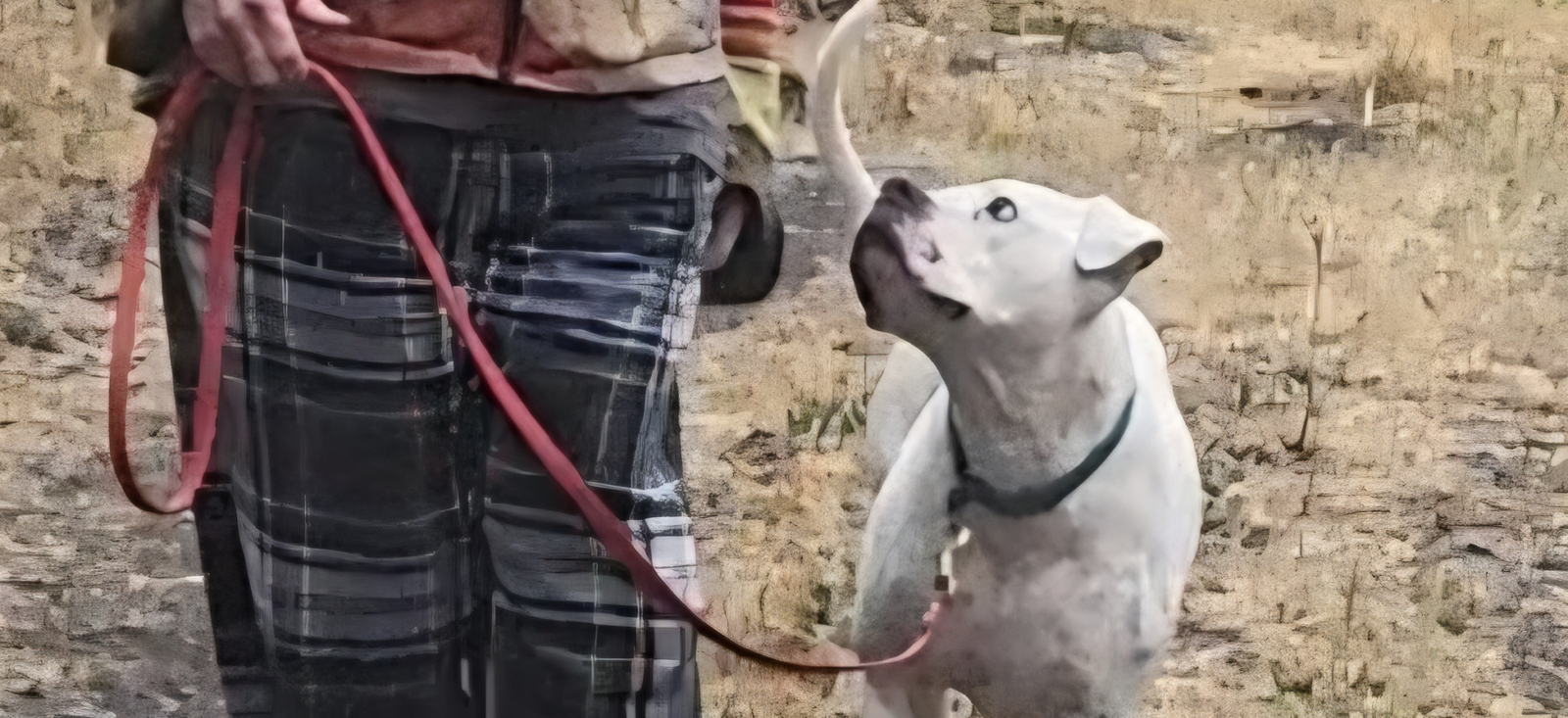
Pulling doesn’t have to be forever. With patience, consistency, and the right approach, you and your dog can have calm, enjoyable walks together. You’ve got this — and so does your pup!
When dogs pull on leash, a few things are generally happening:
- Mismatched expectations: you think you’re going on a civilized walk; the dog thinks it’s adventure time: sniff, explore, and find enrichment.
- Lack of understanding: Your dog doesn’t realize they should yield to the leash, or pulling just isn’t a big deal to them. Many dogs learn to pull because it’s sometimes allowed. Some think it is the only way to get where they want to go, or even enjoy the feeling of pulling.
- Frustration: the leash is limiting the dog’s freedom and ability to make choices and that is frustrating. It’s a really common cause of reactivity. Reactivity is a bigger subject, but all dogs, including reactive ones, benefit from learning leash skills.
The fix does not take forever, but it takes consistency and practice. Teach your dog to yield to leash pressure, practice with a long line and clear cues, then graduate to the 6-foot leash. Start with little or no distraction, then add distraction gradually and intentionally. You should see a huge difference within a couple of weeks with regular practice.
At A Glance
Teach your dog each step until they can pass a simple benchmark test. Then move on to more challenge. Detailed instructions below.
Phase 1: Yield To Leash Pressure
Review fundamentals.
Teach yielding from various angles using praise and food.
Reward attention and teach the correct heel position by luring. Do this several times per day for a day or two..
Phase 2: Loose Leash Walking
Using a 15 ft long line, do repetitive patterns, making turns when the dog passes you or puts pressure on the leash. The pattern is a triangle or square, about 20 ft on a side, and you pause at each corner. The dog can do anything he wants except pull. Praise attention and the dog in position.
Do this every day, adding distractions as the week goes on. Always use a release cue when finished.
Phase 3: Working Walk
Switch to a 6 ft leash. Play a game where the dog only wins and goes forward when he is within a set distance of the “heel zone”. It’s like a dance. Praise effort, keep doing pauses at the corners.
Do this every day. Add distractions as you did in the previous step. Always use release cues.
Phase 4: Refining Your Skills
Build attention: watch for his eyes. Play the game, trying to catch him being distracted. Praise and reward attention, sometimes calmly, sometimes with food or toy play.
Mix in sit and down stays, build duration and distance. Always use your release cue.
Each training topic in the Library is divided into an Intro, At-A-Glance snapshot, Prereqs/Your end of the Leash, Detailed Step-by-Step, and Additional Resources.
At A Glance gives you an overview, the Step-By-Step gives much more detailed instructions.
Related Library Topics (Links will be live soon):
How to Make Everything Easier: Start with Fundamentals
Fulfillment before Obedience
Talking the same language- Clarity and the Windows Model
Your End of the Leash
Motivation and More – Getting Your Game On
Reinforcers and Diminishers
Phases of Training
Tool Selection
Reactivity and Reacting Reasonably
At the end of this process, you should have two fairly reliable options: a long line “free” walk where he can sniff and explore without pulling, and a civilized “attention” walk, where you can get from point A to point B without conflict. There will be further practice as you work on higher distraction and social situations. You’ll accomplish the most if you practice regularly, have consistent expectations, and build challenge intentionally.
Get Your Head Straight – This is not easy for your dog
A lot of people assume that the walk on a 6-ft or shorter leash is natural for every dog, and are surprised at how much conflict they encounter: pulling, lack of attention, even reactivity. It is important to understand a few things:
- Leash Walks are work for your dog and need to be learned. Dogs traveling in groups have a naturally faster gait and larger personal distance from each other. Although they’re traveling together, each one has freedom in how they travel and can choose when to sniff, take a side quest, etc. Just keep in mind walking on leash is unnatural to a dog, it’s a learned skill, and be patient.
- Conflict comes from different goals: You want a quiet walk; your dog wants “free dog” mode. You can both win by balancing structured walks with daily play, freedom, learning, and enrichment (see Fulfillment).
- Your end of the leash is super important. Your tensions, attitudes, emotions and beliefs run down the leash. Be mindful. Take a deep breath and exhale. Relax your arms and shoulders, smile, and focus on your goal not your dog. Believe in your dog. Be silent or speak softly. Be friends.
From now on: No more pulling. For this to work, you need to be consistent, every time.
Ready to begin? Let’s go.
Step By Step
- Take a break from regular walks while you build skills (1–2 weeks). For necessary leashed trips, keep things low-conflict as much as possible.
- Practice first at home, then in low-distraction areas like a quiet park or parking lot. A focused 20-minute session tires your dog more physically and mentally than a regular walk.
- Tools: Selecting the right training collar (or other tool) is important, but the tool does not train the dog; you do. Select a tool that is the mildest option which prioritizes safety and reduces arguing through the leash. A collar is preferable to a harness for clear communication. Do not feel embarassed if the tool you choose has its critics, every tool has its place and it may not be forever. Teach the dog how to respond to the training tool in Phase 1. You’ll also need a 6-ft leash and 15-ft long line. A deeper dive into tool selection is coming soon.
- The Role of Food: Treats are great for teaching new skills, but fade food rewards quickly. Walking should be in “pack drive”, a cooperative activity with forward movement being the reward. Always praise good effort; use treats judiciously.
- Attitude: You don’t need to be a cheerleader, you don’t need to be gruff. Your dog will benefit if you are calm and focused on where you’re going, and will appreciate it if you’re pleasant to be around (not tense or grumpy).
Overall Goal: Teach your dog to maintain a “bubble” near you using your body language and movement (not constant leash tension). Emulate off-leash freedom as much as possible.
Expand each of the sections below for detailed training instructions:
Phase 1: Foundations
Communication: Most people assume their dog understands what it means when the leash becomes tight. This is not necessarily true. The first step is to test/review her knowledge of how to respond to leash pressure. At home, no distraction, with leash and collar:
- Put gradual pressure on the leash, starting from the left or right side. She may lean into the pressure at first, that’s ok.
- Incrementally increase the pressure until she moves toward you.
- Immediately relieve pressure while you mark and reward.
- Repeat 3-5 times, rewarding the yield.
In separate sessions over a couple or three days, do this on the other side, and also directly back (as if she were pulling you).
When she responds to these signals with no distraction, place a few intentional mild distractions at various points and repeat. Use things like food, toys, or a family member ignoring her.
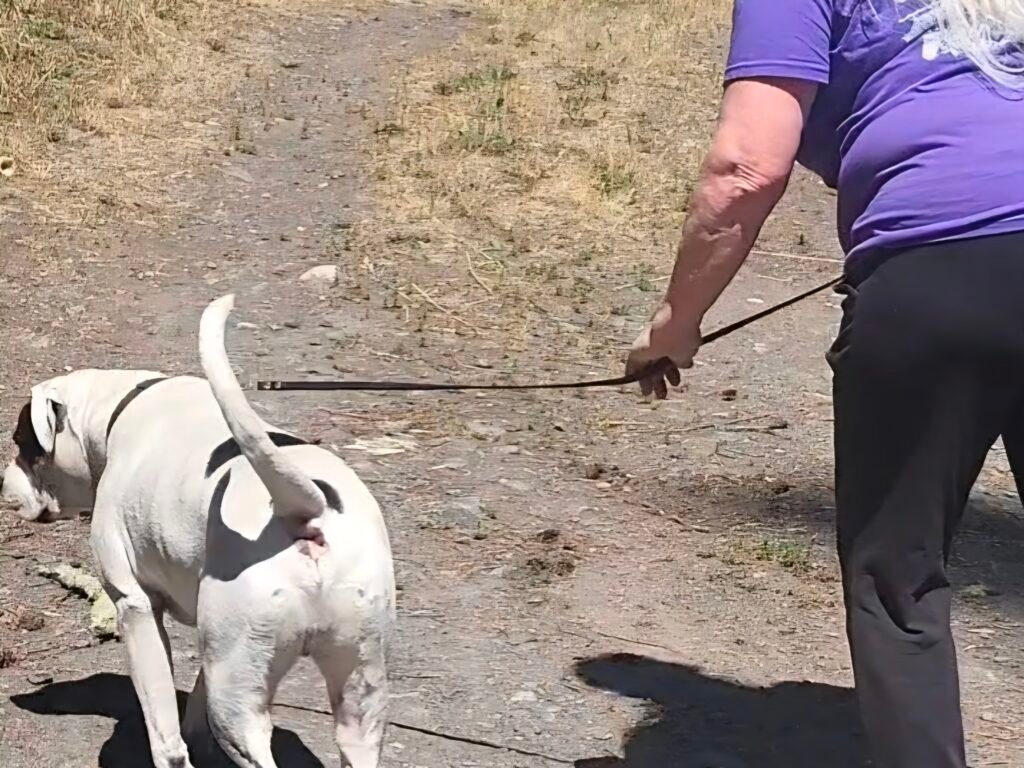
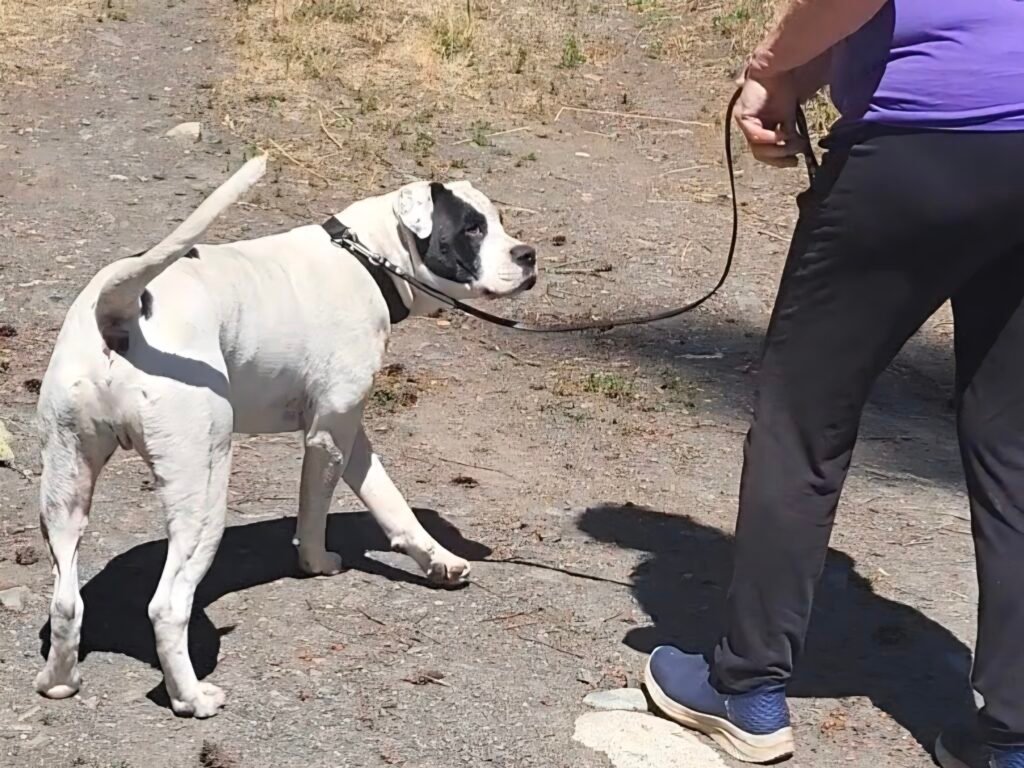
Obviously, we never “yank and crank” on the leash. Keep your hands quiet and low. When walking, use your legs to drive toward your goal.
Optional: Appetitive Pops: Sometimes it is useful to have a physical signal to get the dog’s attention. Collar pops are traditionally an aversive, but they don’t need to be. If you would like to condition a “tap on the shoulder” collar pop, repeat the steps above, applying gentle or even moderate collar pops (depending on your dog, don’t freak them out), and rewarding attention and moving toward you with praise and treats. Make sure you never use this in frustration — always have quiet hands and know when to take a break.
Position: During daily life, reward good heel position and eye contact often (especially when there are distractions). Next, use or teach a heel cue, luring the dog into the desired position with food. Practice this 5 times per day, adding motion after you can get the position while standing still.
Benchmark Test: Spend a day or two on this section’s exercises until you have dependable responses for yielding, collar pops and position (stationary and in motion).
Phase 2: Loose Leash Walk
Use a low-distraction area and 15-ft long line. Imagine a triangle with points 10–20 ft apart (use landmarks or cones).
- Hold the very end of the leash in your right hand, thumb in the loop, close hand over line. Only touch other parts of the line to keep from tripping over it, then drop it again.
- Walk intentionally toward the first point. Dog can do anything except pull. If the dog stays near you, offer gentle praise; then praise and reward at the destination. Pause at each corner point for 15-20 seconds.
- If they reach the end of the line and add leash pressure, just do an about right turn and walk with intention back to the previous point. Keep your hands low and quiet. Use your legs to make your turns. Pause at the corner. Then turn back and go towards your previous goal.
- Practice ~20 minutes (or 6 triangles). Keep it light and fun. Be mostly silent, praise when the dog joins up, and ignore or laugh when you need to make turns.
- At the end, spend 5-10 minutes just hanging out or noodling around calmly. Let her sniff and do what she wants. Then put her away for ½ hour or so to internalize the lesson. The two last steps are important for every training session.
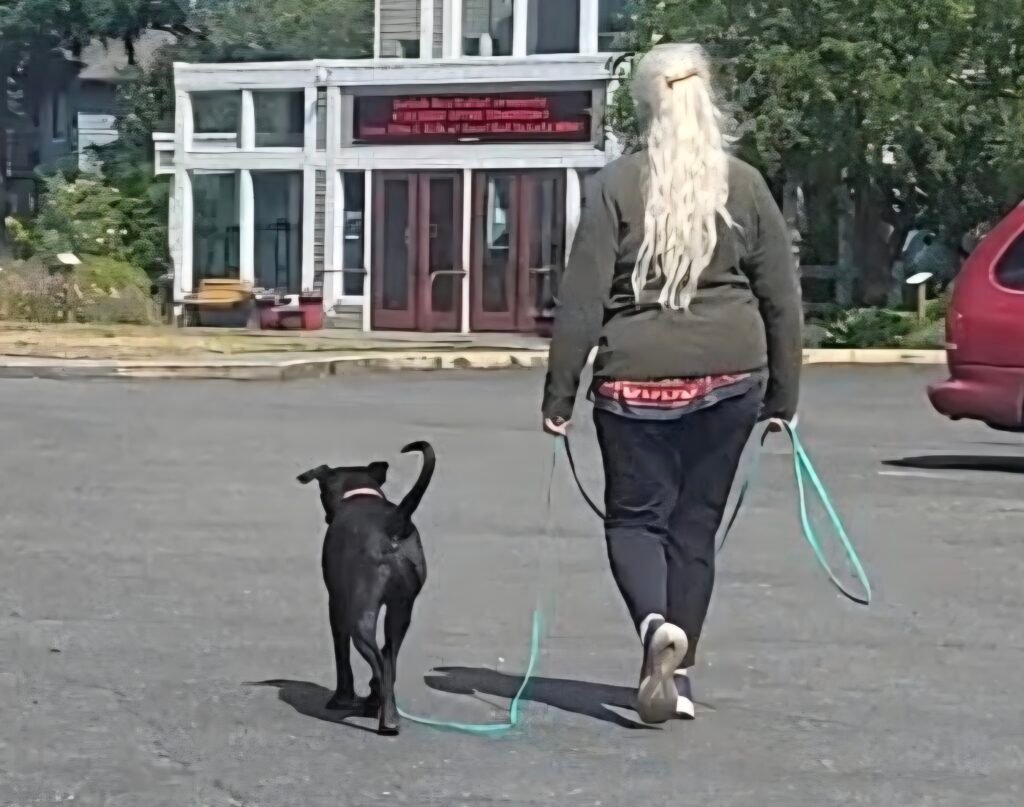
After the first few days, add a cue for Loose Leash Walk (“Let’s Go”). Also, add mild to moderate distractions near each corner of the triangle. See the Distraction Ladder, below. Spend up to a week on this. The long line becomes the default for free, yet civilized, exploration.
Benchmark Test: Have a distraction planted out of sight around the corner of a building, about 5 ft back from your path of travel. The distraction should be one that you’re not sure whether your dog will resist it or not. Having a helper is easiest. Holding the end of your long line, walk toward the blind corner. As you pass the corner and your dog sees the distraction, do a right about turn and hurry back the way you’ve come. If your dog turns to follow before the leash becomes tight, you win! Otherwise, practice more around various distractions until you can pass the test.
Phase 3: Working Walk
In this phase, repeat the Join Up Game, but using the six foot leash. The dog must stay within 3 feet of you at first, as you progress, refine to about 1 foot. Use a different cue for Working Walk (“Heel”), because this signals a criteria the dog must maintain. Always use a release cue when finished.
Keep in mind:
- Dog walking nicely: Reward is praise, proceeding, occasional treat (don’t dig first)
- Any leash pressure by dog: Stop, change of direction (right or left turn), the reward is the pressure releases and walk continues (no treats)
- Be soft on the leash, keep the process enjoyable for both of you.
Helping the dog through mistakes:
- Pulling: drop any slack you’re holding (hold the end of the leash), about right turn, go the opposite direction.
- Forging: if the dog starts to pass you and you can still make a left turn safely, do so. With an appropriate amount of leash in your left hand, lift straight up to apply slight tension/check the dog’s forward movement, circle left, drop your left hand as the dog returns to position.
- Ducking: if the dog drops back and tries to get over to your right side behind you, you’ll feel the leash against the back of your legs. Stop, back up a big step or two until the leash becomes tight, and wait. The dog will figure out that he needs to return to your left side to relieve the leash pressure so you both can continue.
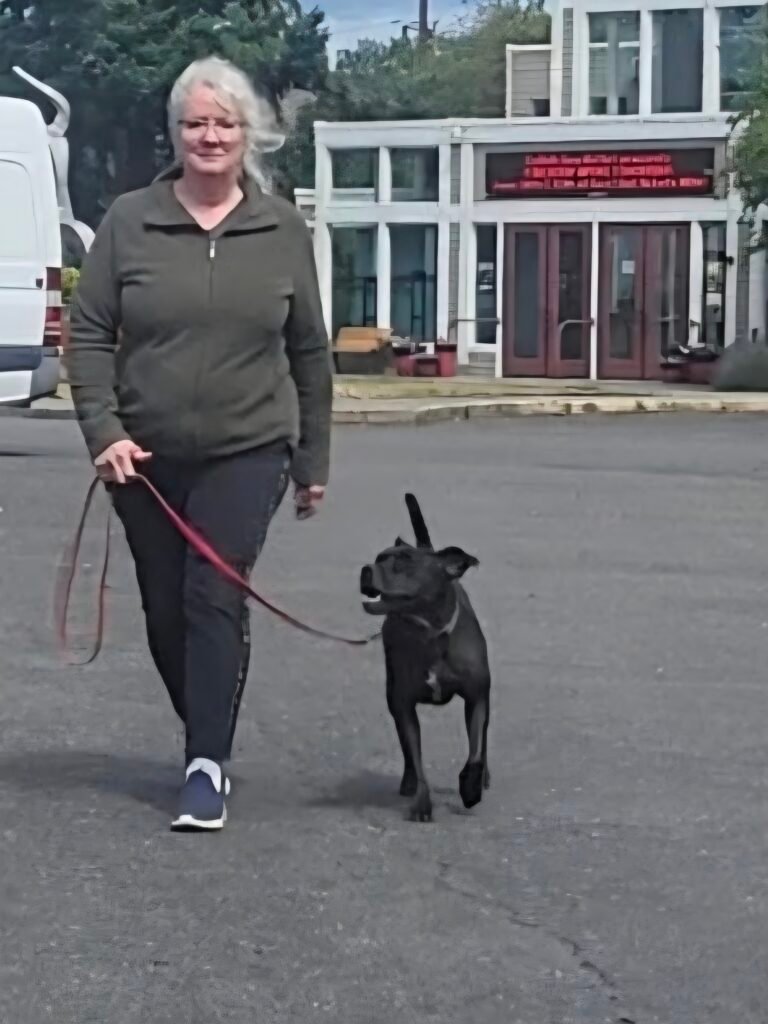
–> Make every place a nuisance except where you want. Praise the dog returning to position, occasional treat optional.
Sessions should be pleasant, not a battle of wills. Try to end each session on a rewardable note, then release your dog (calmly) to relax and enjoy some free time on the long line. Ideally, the release should be emotionally neutral or even a little flat – NOT “yay, work is over!”.
Remember: Leash walking is work for your dog. It’s a learned skill, not a natural behavior. Your job is to make it as pleasant and clear as possible. Once good habits are formed, the leash should no longer create conflict — but it always remains a rule that must be maintained. Never allow pulling when you give a heel or working walk cue.
- Use your turns to correct pressure.
- Always give a clear release cue when the session ends.
- Don’t let your dog decide when the structured walk is over — that makes it unfair to expect them to hold criteria later.
If things become frustrating or your dog is getting mentally tired, find something rewardable, take a deep breath, then switch to the long line and Loose Leash Walk.
Benchmark Test: Set up a rectangle about 10 ft by 15 ft with markers at each corner. Place different distractions at each point. Using your working walk, navigate around the course, first clockwise (you between the dog and the distraction). Pause a few seconds at each corner, then cue and continue. Repeat the opposite direction, pausing within about 3 feet of each distraction. If you can complete the exercise without having to do any corrective turns, you level up! Otherwise, practice more around distractions and try again.
Level 4: Solidifying Habits
Once you have the Working Walk, you don’t have to do the triangle any more, but increase distance between pauses gradually. Count your steps, or choose landmarks to walk toward. If you start losing the dog mentally, stop and take a break to Loose Leash for 20 or 30 seconds. Then gather your dog, say your cue and continue.
Practice through doors, gates and other pinch points, anywhere your dog likes to rush. Distractions you encounter are just like your purposeful distractions – add distance to help your dog be successful as needed. Left turns / left circles send a clear message to the dog. You can also do an about turn and go back the way you came. If you’ve been practicing your stays, you can sit or down the dog and have them stay as the distraction passes. If not, start practicing them now.
Stays
Break up your sessions with a few long stays, having your dog sit or down. Build duration 10 seconds at a time plus 1 foot of distance daily until you have 60 seconds and 6 feet. This helps the dog practice regulation, and gives contrast and mental rest during your walks. In future weeks, you can and should continue with more distance and duration using the long line, out of sight stays (hide around a corner) and gradually increasing distractions during stays.
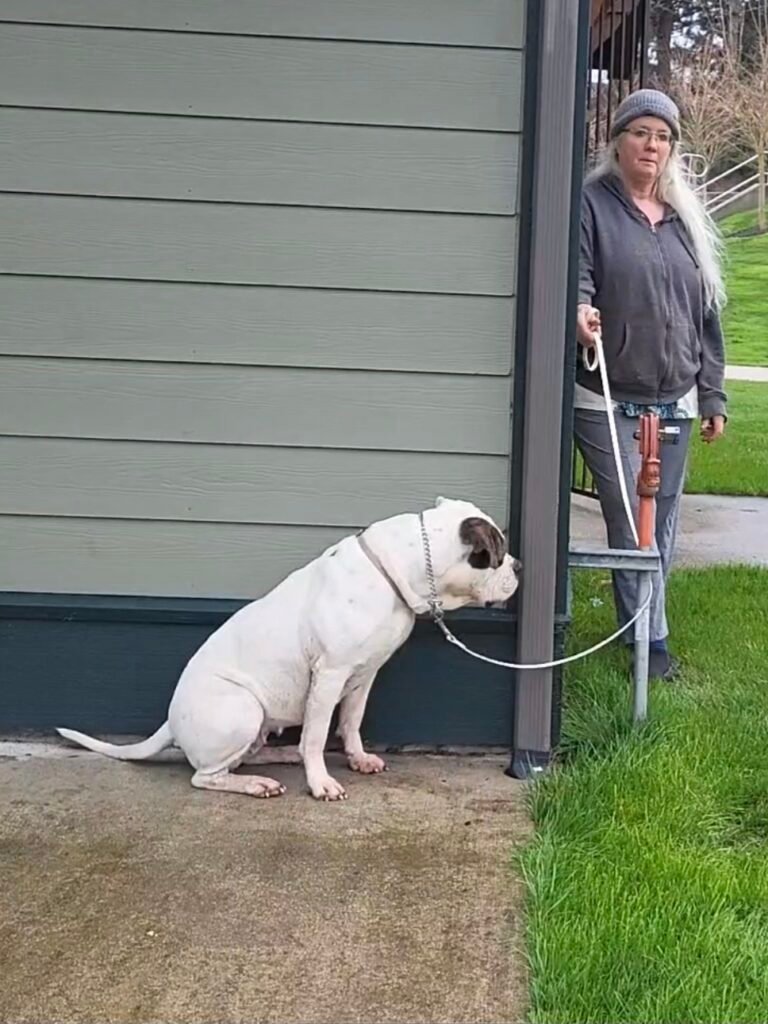
Benchmark Test: Pick a route that you’ve practiced that is about 200 feet from beginning to end. There should be moderate environmental distractions, or plant several distractions to the right and left along your route. Walk to your goal and back, including 2 stays at 6 ft distance, at least one for a full minute. If you can navigate there and back without corrective turns, you level up! If not, practice more and try again.
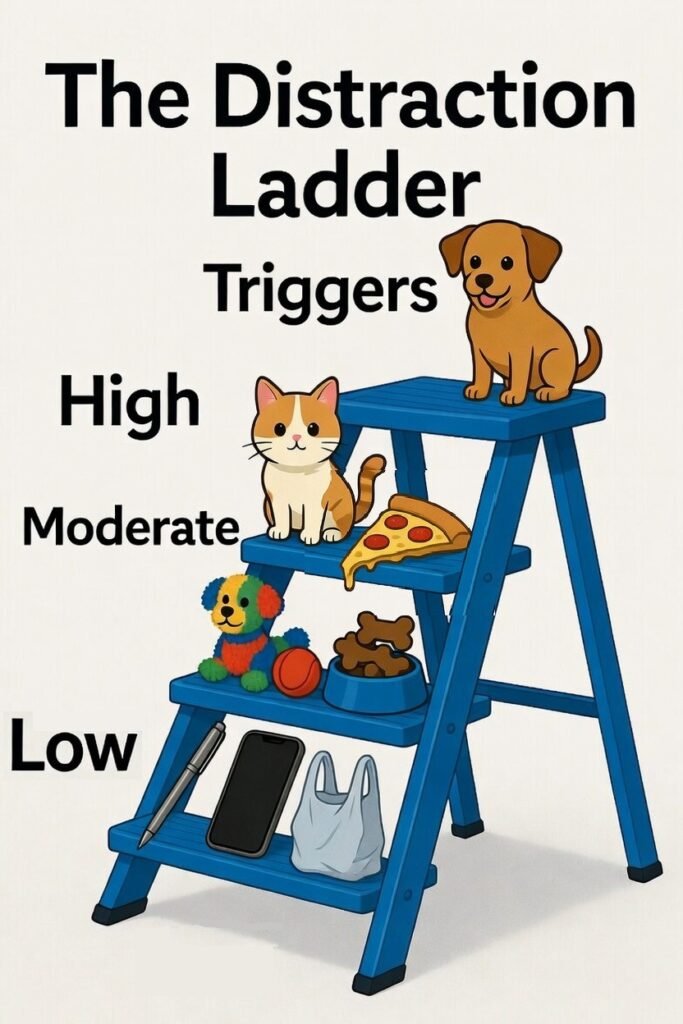
The Distraction Ladder
When adding distraction to your daily practice, increase challenge gradually. Add mild, moderate and challenging distractions to your game each week. Your dog decides what is distracting, and what level of difficulty it is. Keep distractions challenging, but achievable. If things get overwhelming, ease up, add distance and end on a good note.
Day 1-2: Mild: a “what’s that?” reaction. A plastic bag, an object out of context. A known person or tethered dog ignoring them, or a person dropping a pen or other neutral object as they approach.
Day 3-4: Moderate: A “want that” reaction. A toy, a bowl with food, a sandwich on a plate, a friend looking at them (NOT calling them), a neutral dog at an appropriate distance. Moderate distractions start with stationary, not moving, objects.
Day 5-6: High. Anything really tempting, but that you think the dog has a 2 in 5 chance or better of being successful resisting. Things in motion, novel things, noisy things. Kids, dogs, animals, bikes. Eventually, triggers, but not until later.
Key Rules for Distractions
- While training, never let your dog reach or “win” the distraction (no sniffing the object or meeting the person/dog). Maintain enough distance so your dog can ignore it. Greeting skills are a separate training item – for now aim for neutrality.
- Progress one level at a time (mild → moderate → high). Spend at least 2 days on each level before advancing.
- Distance is your friend—use it to set your dog up for success.
Distractions are a moving target: What’s moderately distracting in week 1 may barely register in week 2, so you’ll need fresh challenges. Stay emotionally neutral yourself—your dog will mirror your energy. Note any emotional reactions from your dog, but stay on task. If barking or stress lingers, clearly communicate the item is off-limits. If you’re still struggling, consult a professional trainer.
You should see noticeable progress every week. Practice in daily life, to and from the car, in and out of the door and gates, etc. Practice where your dog likes to rush, one location at a time.
Going Forward
From here, practice going back and forth between the Loose Leash Walk and the Working Walk. Make sure the difference in criteria are really clear to your dog. If you are working toward a default working walk, continue to use your cue as needed. Start walking, if your dog doesn’t automatically go into working walk, just tell them. Always give an explicit release command to Loose Leash Walk. Then, when done, gather the leash and start walking, cue as needed.
As you practice, if you are consistent, it will become reasonable for you to expect a Working Walk whenever you hold less than 6 feet of leash, even when you don’t specifically give the cue. When you’ve practiced the same picture hundreds of times, with consistent expectations and body language, the dog will understand that picture and probably do it automatically. You can have a default working walk from the house to the car, for example, and in other common situations. But be fair: if you sometimes allow the dog to run to the car, then you will need to cue the working walk indefinitely for that situation.
Troubleshooting and Resources:
As you continue practicing, there may still be specific situations where your dog struggles, or that are too much for them to navigate calmly. Practice makes better, but also review the topics in the sidebar above. Some triggers need to be addressed specifically, please refer to the topic on Reactivity in the Library.
If you have trouble or plateau in your work, come to club, seek one-on-one help, or contact a professional dog trainer.
Links and other resources will be posted below as they become available.